How can a Belgian SME get recommended by ChatGPT? What the tests show, and what they don't.
Nobody can guarantee you a place in ChatGPT's answers: OpenAI has not published how it ranks businesses, as the agency WebFX points out, and the same question gives different names from one time to the next. Early independent tests still show what carries weight: a website that says clearly what you do and where, enough reviews and a presence in sources the assistant considers reliable. Much of this is simply good local SEO.
The audience is there. According to the Ipsos survey carried out for Google among 1,000 Belgian adults, 61% of them used an AI chatbot in 2025. The FPS Economy counts 42.01% of Belgians aged 16 to 74 who used a generative AI tool over three months. Traffic, on the other hand, remains modest: SEOcrawl measures 1.25 sessions from an assistant for every 100 sessions from Google search, on its customers' websites, and ChatGPT accounts for 83.3% of that assistant traffic.
For a Belgian SME, the point is therefore not to redirect everything towards AI. It is to exist on the day a prospect asks: "Which accountant would you recommend in Namur?" One limit to keep in mind: no public study found to date tests the Belgian market. The figures below come from the United States, Canada and the United Kingdom. They are trends, not laws.
How ChatGPT chooses a local business
A web search, not just a memory
For a local question, ChatGPT can search the web and summarise what it finds. OpenAI says in its help centre that it may use an approximate location based on the IP address, and share it with third-party providers to obtain, for example, listings of nearby businesses.
The direct consequence: if your website is blocked for OpenAI's search robot, you take yourself out of the game. Blocking GPTBot concerns model training. Blocking OAI-SearchBot removes you from ChatGPT's search results, according to several specialist analyses of its documentation. The two settings are independent.
The role of Bing: an observation, not a published rule
Several local SEO specialists, including Local Falcon, believe ChatGPT has no direct connection to your Google profile and relies notably on Bing Places and on directories. None of this is officially documented. The step is still inexpensive: Bing Places is free and, since its October 2025 redesign, lets you import an existing Google profile, according to PPC Land.
What the tests actually observe

One of the most detailed studies this autumn comes from 8ight.AI, a company that sells AI visibility services, as it points out itself. In September 2026, it tested 2,976 local businesses in 39 trades, in the United States and the Toronto area. ChatGPT named only 12.4% of them. Not appearing is therefore the normal situation, not an accident.
Reviews: volume more than rating
ChatGPT named 3.4% of businesses with fewer than 25 Google reviews, against 22.2% of those with 1,000 or more. The median is 175 reviews for the businesses named and 97 for the others. The median rating, however, is identical in both groups: 4.9 out of 5. An excellent rating with a handful of reviews is therefore not enough to stand out.
A word of caution: this is a correlation. A business with many reviews is often older, larger and mentioned more widely. Collecting reviews regularly is useful in any case, since it also serves your customers and your Google ranking.
Your own website counts more than expected
In the same study, 68.1% of ChatGPT's answers cite the website of a business found on Google Maps. In the United Kingdom, a Whito log of 18 answers finds business websites in 9 of them. WebFX, on an emergency plumber question in San Francisco, notes that 12 sources out of 12 are contractors' websites. These last two samples are small, but they point the same way: the assistant reads your website if it answers the question.
Third-party sources vary by country
In the United States and Toronto, ChatGPT cites the Better Business Bureau in 38.7% of answers and a government or professional licensing site in 25.1%. Yelp appears in none of the 1,412 answers. In the United Kingdom, the Whito log sees Reddit in 10 answers out of 18, while the North American study records it only 6 times in 1,630 answers from ChatGPT and Claude combined.
The lesson is not to go on Reddit. It is that the recipe varies by country and trade. In Belgium, the logical equivalents would be public registers, professional federations and serious sector directories. That is a common-sense transposition, not a measured result.
What a Belgian SME can actually do
None of these actions is specific to AI, which is good news: nothing is lost if the assistants change their method.
- Write pages that answer the question: one page per service, with the trade, the area served, lead times and the cases you do not handle. A vague website gives the assistant nothing to summarise.
- Cover your languages: a Flemish prospect will ask in Dutch. A page in French alone does not answer them as well.
- Align your details everywhere: same name, same address, same phone number on your website, Google profile, Bing Places and directories, with your company number visible.
- Show verifiable proof: approvals, certifications and memberships you actually hold, with a link to the register where one exists.
- Check technical access: make sure your robots.txt file does not block OAI-SearchBot.
- Look after your local presence: the work described in the guide to local SEO in Belgium remains the foundation.
How to measure without fooling yourself
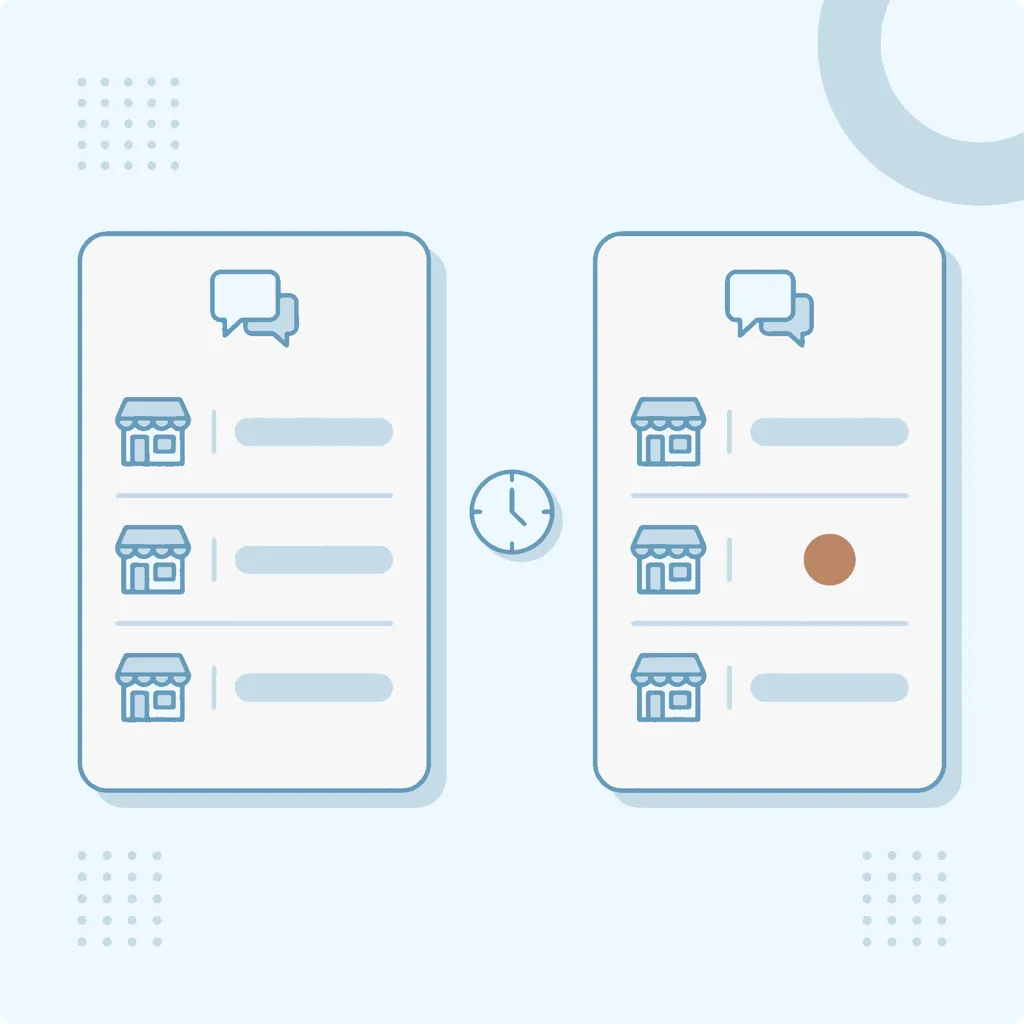
A flattering screenshot proves nothing, and the 8ight.AI study illustrates this. Asked twice, 39 minutes apart, the same question gives a median of only 29% of names in common.
Asked twice, 39 minutes apart, the same question gives a median of only 29% of names in common.
A simple method comes down to three steps:
- List 10 questions your prospects really ask, in your languages.
- Ask each question several times a month, in a new conversation, and note whether you appear and which sources are cited.
- Ask where contacts come from: add a question to your form about how the prospect heard of you, with "AI assistant" among the answers. In Google Analytics, assistant traffic is only a floor, as SEOcrawl stresses, because some visits lose their origin.
This log gives you a trend. It will not give you a position, because there isn't one.
Frequently asked questions
Can you pay to be recommended by ChatGPT?
Ads have been shown in Belgium since 24 August 2026, but they are a labelled placement below the answer, not a recommendation in the text. The subject is covered in the article on advertising in ChatGPT. The two approaches are separate.
Should ChatGPT take priority over Google?
No. With 1.25 assistant sessions for every 100 Google sessions according to SEOcrawl, Google remains by far the main source of visits. That proportion is growing (it was 0.70 a year earlier), and the foundations serve both: start with them.
Can an agency guarantee a recommendation?
No. Answers vary from one time to the next and the method is not public. Be wary of any promise of results in an assistant's answers: what can be promised is the work done and honest tracking.
My business doesn't appear: is that serious?
Not in itself. In the 8ight.AI study, nearly nine out of ten businesses tested are not named by ChatGPT. The signal to watch is rather a competitor who appears systematically on your key questions: look at the sources cited for them.
Priority action plan
- Test today: ask ChatGPT three of your prospects' questions and note who is cited, and from which sources.
- Remove the blocks: check your robots.txt file and the accuracy of your details everywhere online.
- Rewrite your key pages: trade, area, lead times and proof, in each of your languages.
- Start collecting reviews regularly: a few requests a month are worth more than a one-off campaign.
- Keep the log every month: same questions, same notes, and a review after six months.
This work has a rare advantage: even if it brings you no recommendation from ChatGPT, it will still have strengthened your website, your reviews and your local SEO. The risk is low, and the log will quickly tell you whether the effort is paying off.
Want to know where your SME appears, and what is holding it back? We'll look at it together: visibility support.